
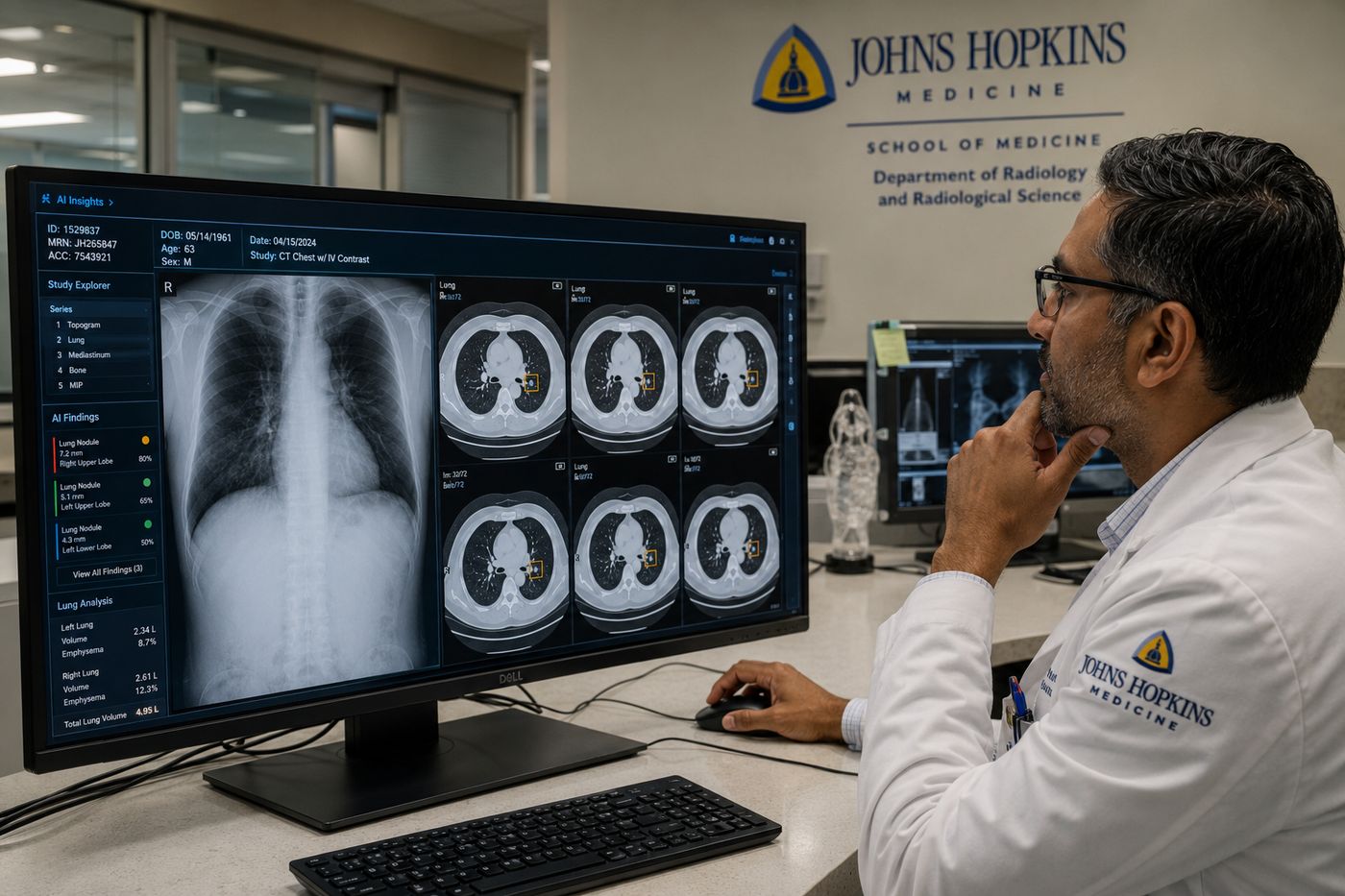
Artificial intelligence models are identifying signs of pancreatic cancer up to 16 months before human physicians can detect them — a potential breakthrough for one of the deadliest cancers in medicine, where the difference between an early and a late diagnosis is frequently the difference between a treatable condition and a death sentence.
Dr. Peter A. Najjar, a surgeon and vice president for clinical innovation at Johns Hopkins Health System, told Fox Business Network this week that AI is enabling researchers to recognize imaging patterns in pancreatic tissue that would otherwise take physicians decades of clinical experience to identify — and to spot those patterns in scans taken months before any conventional diagnostic process would flag a problem. Pancreatic cancer carries an overall five-year survival rate of just 13%, largely because it is almost always diagnosed after it has already spread beyond the pancreas. When it is caught before metastasis, that survival rate rises to 44%. A 16-month window of earlier detection — if the research holds up in broader clinical trials — could represent one of the most consequential advances in oncological screening of the past decade.
"Researchers were able to identify signs of pancreatic cancer up to 16 months ahead of human readers. Detection always allows us more treatment options." — Dr. Peter A. Najjar, Johns Hopkins Health System
The same AI models being applied to early detection are also accelerating drug discovery. Najjar explained that many cancer treatments depend on identifying which molecule binds to the correct protein for a given tumor type — a process that has historically required years of laboratory testing. AI dramatically compresses that timeline by allowing scientists to model molecular interactions computationally before committing to physical laboratory trials, reducing both the time and cost of getting candidate treatments to clinical evaluation. The technology is also improving day-to-day patient care through AI-powered medical scribes that organize records before appointments and automatically document visits — giving physicians more face time with patients and less time on administrative documentation.
Najjar was careful to temper the excitement with appropriate scientific caution. The AI pancreatic cancer detection research is promising, but it has not yet been validated at the scale and in the diverse patient populations required for routine clinical deployment. The technology is still early — and the gap between a promising research result and a standard-of-care screening tool involves regulatory approval, clinical validation, health system integration, and years of real-world performance data. "We absolutely need to move full speed ahead to bring this promise to our patients in the clinic," Najjar said. "But it is still very early days."
Pancreatic cancer is the third-leading cause of cancer death in the United States, killing approximately 55,000 Americans annually. Notable victims include Apple co-founder Steve Jobs, actor Patrick Swayze, and Jeopardy! host Alex Trebek. The cancer's lethality is directly tied to its late-stage diagnosis — most patients are not diagnosed until the disease has spread to other organs, at which point surgical removal is no longer possible and treatment options are significantly more limited.
Sixteen months of earlier warning on pancreatic cancer — if that finding survives the rigor of large-scale clinical validation — would be one of the most significant medical advances in a generation. For a cancer that kills nearly everyone it reaches late, a 16-month head start is not a marginal improvement. It is potentially the difference between surgery and hospice. The private sector research driving this work deserves continued investment and expedited regulatory pathways. The patients who will benefit from it cannot afford to wait.