
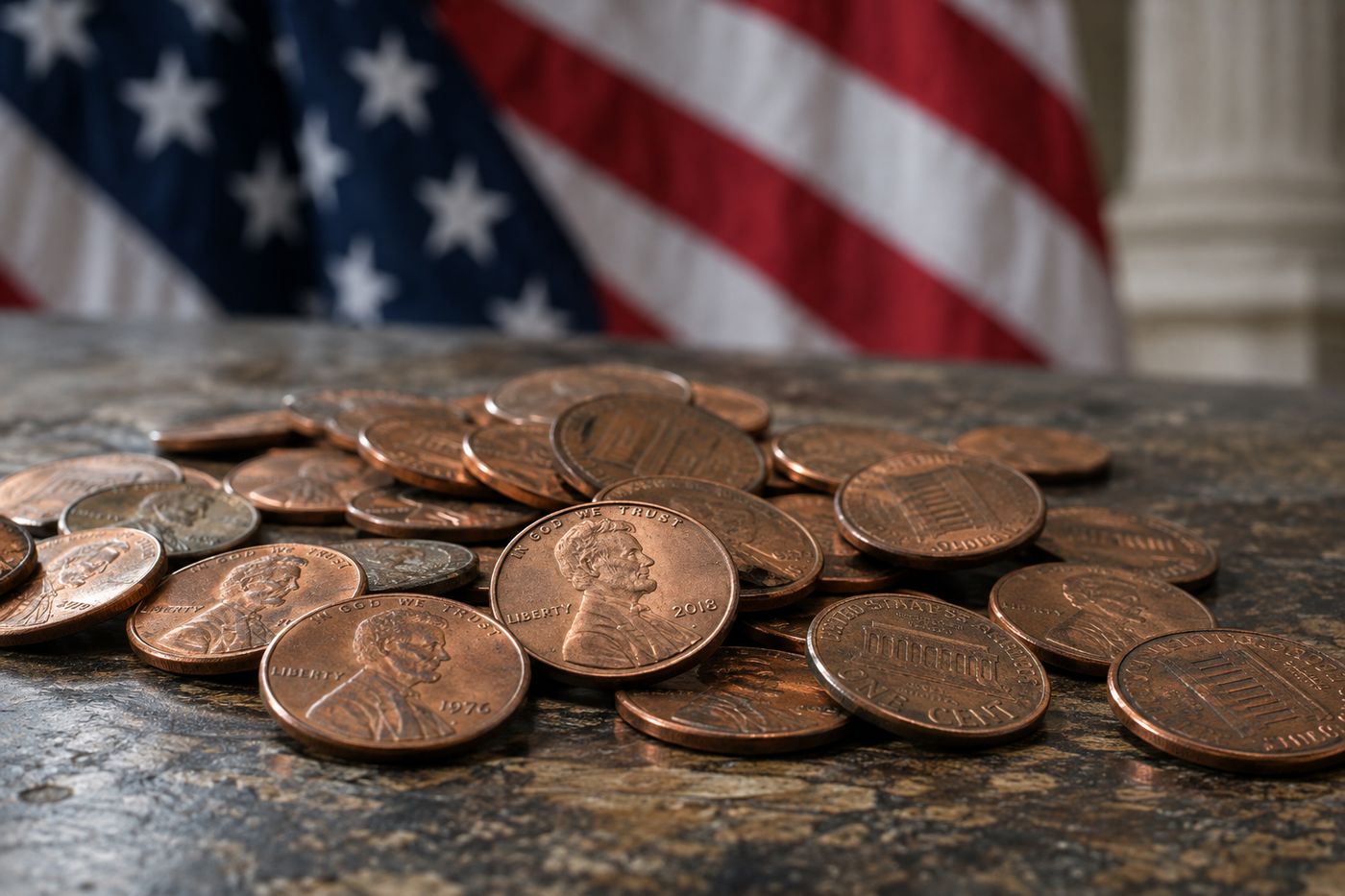
The House of Representatives passed the bipartisan Common Cents Act by unanimous vote Monday, permanently blocking the U.S. Mint from producing new pennies — except for collector coins — and establishing a framework for rounding cash transactions to the nearest five cents, delivering formal legislative sanction to what the Trump administration's Treasury Department had already accomplished administratively when it halted penny production in November 2025.
The bill was led by House GOP Conference Chair Lisa McClain of Michigan and Rep. Robert Garcia of California — the top Democrat on the House Oversight Committee — a pairing that illustrates just how rare truly unanimous agreement is in the current Congress and how thoroughly the economics of the penny had already settled the argument. The math has been obvious for years: it costs the U.S. Mint more than three cents to produce each one-cent coin, meaning the federal government loses money on every penny it makes. The Treasury estimated annual savings of $56 million from halting production. The Common Cents Act now enshrines that decision in law, preventing a future administration from reversing course, and adds the cash rounding framework — a standard practice already in use in Canada, Australia, the European Union, and dozens of other countries — that allows the coin's absence from circulation to actually function in everyday transactions. An exception was written for cash wages, which must round upward if the total is not divisible by five cents. Existing pennies remain legal tender.
"Americans may soon no longer be able to offer a penny for their thoughts — because the one-cent coin will be relegated to the ash heap of history." — Fox News, on Monday's unanimous House vote
A December 2025 ceremony at the Lincoln Memorial — where penny advocates held a mock "funeral for the penny" after the Trump administration's production halt — turns out to have been somewhat premature in its theatrical mourning, given that it took until September 2026 to get the legislation through the House. But the bill's unanimous passage is a meaningful milestone: the one-cent coin had been the subject of annual abolition proposals in Congress for at least two decades, each time dying without a vote because of a combination of nostalgia, lobbying from zinc producers who supply the metal that makes up 97.5% of the penny's composition, and the perceived political danger of touching anything Lincoln-adjacent. The unanimity of Monday's vote suggests all of those obstacles have been definitively overcome. The bill now heads to the Senate, where a companion bill has garnered bipartisan support and is expected to move quickly. The bill also includes a provision allowing the Mint to produce nickels from cheaper materials — an efficiency measure that could produce additional annual savings beyond the penny's elimination.
The rounding framework — perhaps the provision that drew the most attention in public discussion — works simply: cash purchases are rounded to the nearest five cents, meaning a $1.02 item costs $1.00 in cash and a $1.03 item costs $1.05. Electronic transactions — credit cards, debit cards, digital payments — are not affected and continue to calculate to the penny. The Congressional Budget Office and multiple independent analyses of comparable rounding systems in other countries have found that rounding is essentially neutral over time for both consumers and retailers, with rounds-up and rounds-down occurring with approximately equal frequency across typical shopping baskets.
The U.S. penny has been in continuous circulation since 1793 — a 232-year run that the Trump administration effectively ended administratively in November 2025 by directing the Treasury to halt new production. The Common Cents Act makes that decision permanent by statute. Canada eliminated its penny in 2013 and found no adverse effects on consumer prices or low-income shoppers. Australia eliminated its one-cent and two-cent coins in 1992. The bill directs the Treasury to study the rounding system's effects on low-income consumers, elderly shoppers, and unbanked individuals who rely on cash to ensure no group is systematically disadvantaged.
The unanimous House passage of the Common Cents Act is one of the genuinely rare cases where government has done something obviously correct, where both parties agreed it was obviously correct, and where the outcome — permanently ending production of a coin that costs more to make than it is worth — produces real savings for taxpayers at essentially zero cost to anyone. The Senate should act quickly. The penny had a good 232-year run. It is time.