
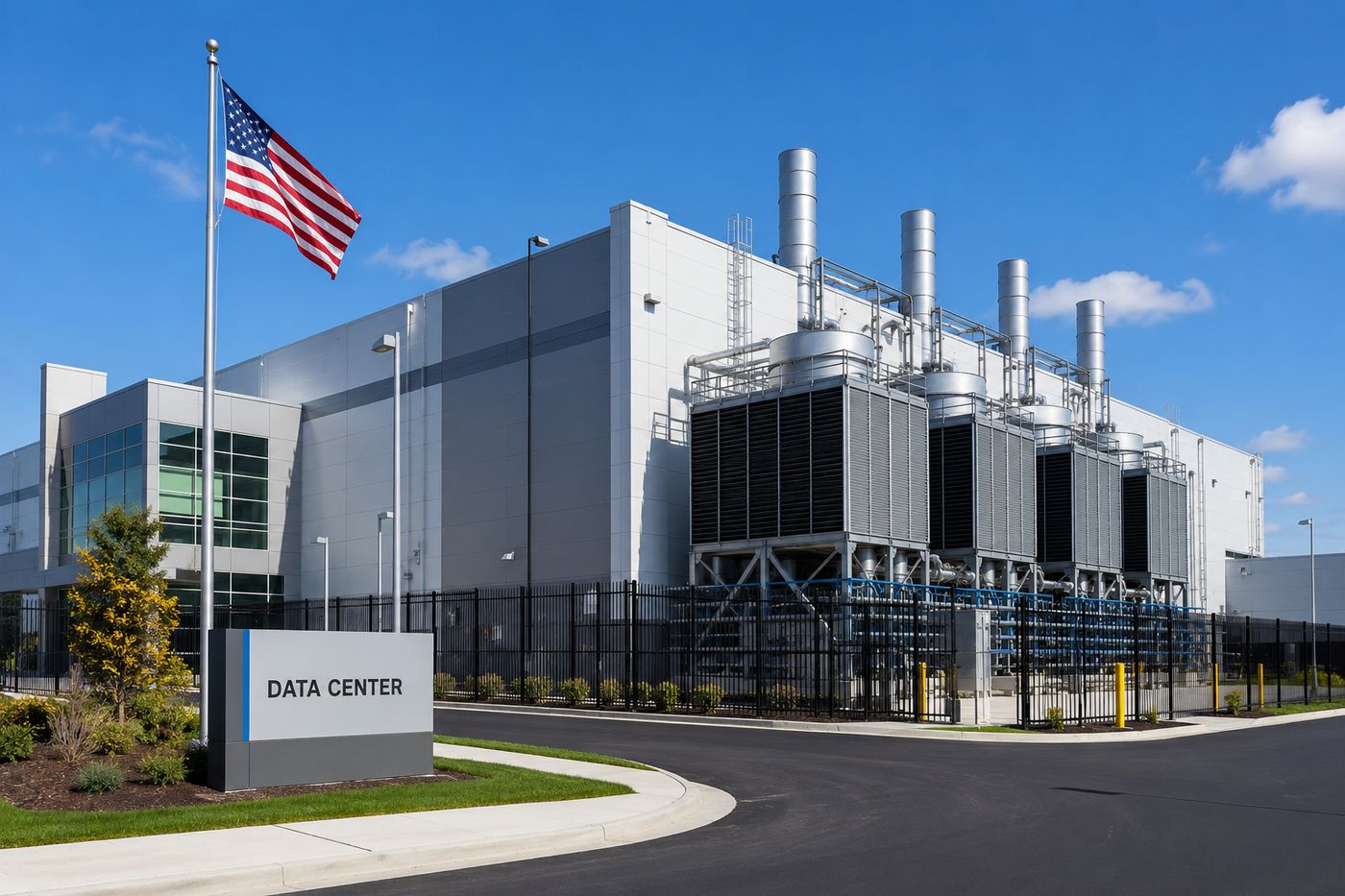
Seventy-eight local jurisdictions across the United States have enacted temporary moratoriums or outright bans on new data center construction — and if the movement spreads to statewide mandates and wins the backing of a major political party, experts warn that the only clear winner will be China in an AI race that America is currently winning but cannot afford to take for granted.
New York has already imposed a statewide data center construction moratorium. Fourteen other states are considering similar measures — including red states like Florida, Oklahoma, and Georgia — as concerns about energy consumption, water use, and local infrastructure strain have given the anti-data center movement genuine bipartisan traction. The concerns are real: a single hyperscale data center can consume as much electricity as a small city and draw enormous quantities of water for cooling. But the strategic cost of restricting AI infrastructure at this particular moment in history could dwarf any local inconvenience. The United States currently controls approximately 75% of global AI compute capacity. China controls roughly 15%. That 60-point advantage did not emerge by accident — it reflects decades of private sector investment, stable regulatory environments, and a national energy infrastructure willing to power the facilities that make AI possible.
"The decisions we make now about the future of data centers will have a decisive impact on the future of freedom. Either way, it's crucial that Americans choose the right path — one that truly benefits us and not our adversaries." — Arthur Herman, Hudson Institute
China's AI strategy is explicit, well-funded, and focused on both military application and civilian control. While American AI development is aimed at productivity, innovation, and individual empowerment, Beijing's AI program is designed to deepen surveillance of its own population and extend its model of authoritarian governance globally. The AI war is not a metaphor — it is a strategic competition between two incompatible visions of what artificial intelligence should do in the world. Data centers are the factories of that war. Restricting them in the United States because of local energy or aesthetic concerns is the strategic equivalent of shutting down defense plants during a conflict. Georgia alone stands to lose 552,000 jobs and $850 million in annual tax revenue if its proposed data center ban takes effect.
The Trump administration has made AI infrastructure a national priority, fast-tracking data center permitting and treating compute capacity as a strategic asset comparable to military readiness. That posture is correct and necessary. But federal policy cannot override 78 local jurisdictions acting on genuine constituent concerns about power consumption and land use. The solution is not to dismiss those concerns — it is to build the energy infrastructure, streamline the transmission grid, and develop the next generation of cooling technology that allows data centers to coexist with the communities that host them.
U.S. AI compute capacity advantage over China is partially offset by China's significant lead in industrial AI applications — deploying AI across manufacturing, logistics, and supply chain management at scale that American industry has not yet matched. China has also treated AI as a core military priority, integrating it into unmanned systems, intelligence analysis, and battlefield logistics in ways the U.S. military is actively working to replicate. The two nations control approximately 90% of global AI compute capacity between them, with all other nations holding a combined 10%.
Banning data centers because they use electricity is like banning shipyards because they use steel. The energy problem is real and worth solving. The water consumption challenge is genuine and worth managing. But the solution is investment in better technology and smarter infrastructure — not moratoriums that hand China the runway it needs to close a gap it has been working to eliminate for a decade. Americans need to understand what is actually at stake in the decisions their city councils and state legislatures are making right now, and they need to demand that policymakers treat AI infrastructure with the same national urgency they would apply to any other decisive strategic asset.