
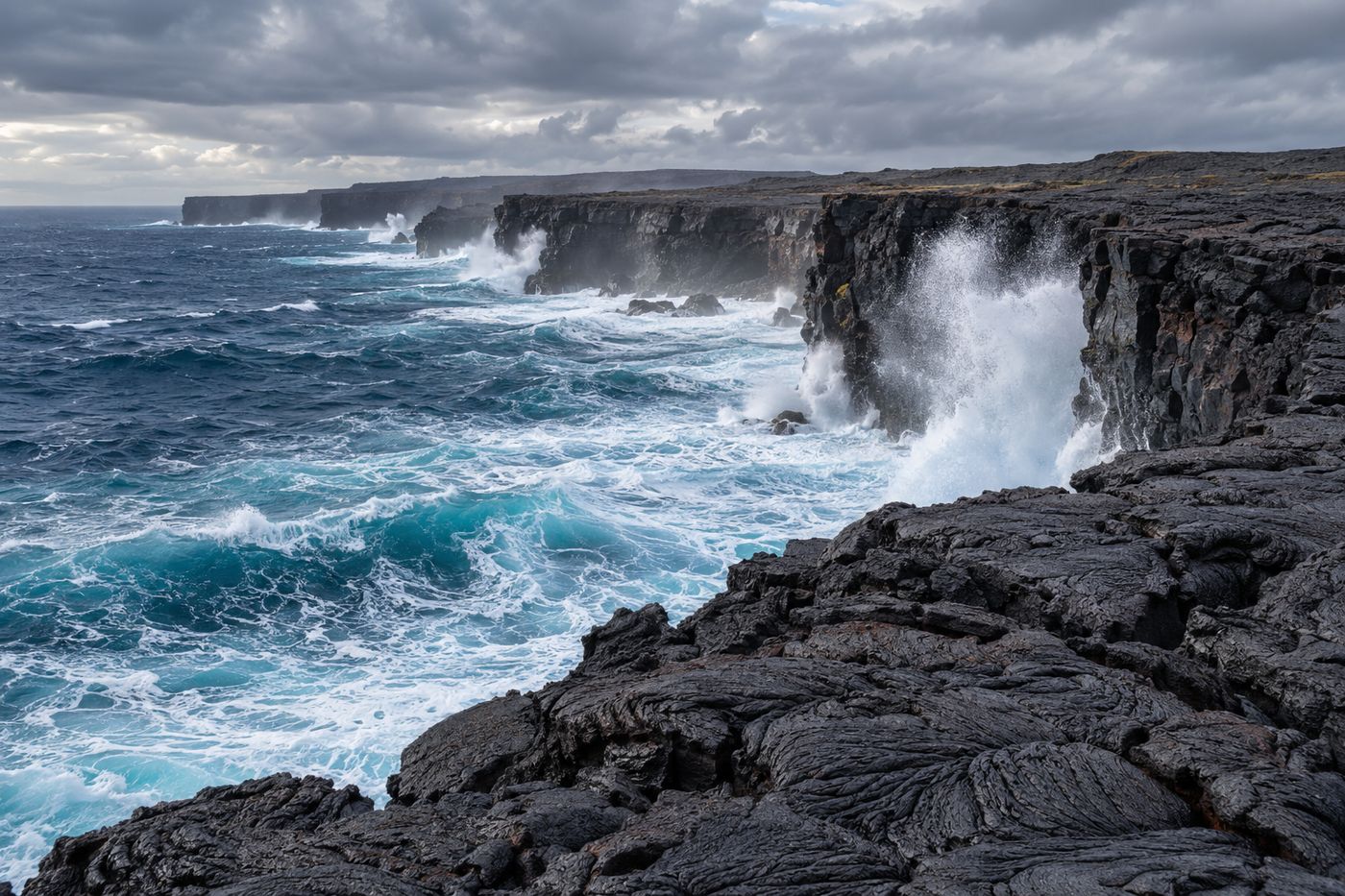
The Hōlei Sea Arch — a 90-foot natural lava formation that stood on the southern coast of Hawaii's Big Island for more than 550 years and drew visitors to Hawaii Volcanoes National Park for decades — has collapsed into the Pacific Ocean, the National Park Service confirmed Thursday, in a geological event that park staff had long anticipated but could not predict.
The arch was still standing on Wednesday, September 23, when the park was temporarily closed due to Tropical Storm Nolo. When the park reopened Monday, September 28, it was gone. The exact moment of collapse is unknown and may have occurred during the tropical storm's high surf and wind conditions. A photograph taken September 30 shows empty space where the arch once stood — a stark before-and-after that Volcanoes National Park shared on Facebook and Instagram alongside a message that combined genuine mourning with characteristic geological perspective. "Yes, it's true. RIP Hōlei Sea Arch," the park posted. "Hōlei Sea Arch was a very special place to so many of our visitors." The arch formed approximately 550 years ago when ancient lava from one of the island's six volcanoes reached the coastal cliffs and hardened into basalt, which was then gradually carved by the relentless action of Pacific waves through a process known as differential erosion — the same process by which softer rock is worn away faster than harder, more resistant rock, ultimately creating the arched void that became one of the Big Island's most recognizable features.
"The sea arch will eventually crumble into the sea. Landscapes are routinely reshaped through differential erosion, and it is how the arch came to be more than five centuries ago." — Hawaii Volcanoes National Park, on the Hōlei Sea Arch's eventual collapse, stated years before it occurred
Park staff had been warning about the arch's instability for years. Earthquakes during the catastrophic 2018 Kīlauea eruption and summit collapse damaged the cliffs near the arch and accelerated the erosion process. Large surf from Tropical Storm Darby in 2018 broke off a chunk of rock from the lower arch, and the NPS warned at that time that complete collapse could occur at any point. A safer viewing area further from the cliff edge was opened in March 2020 specifically because the original viewpoint had become too dangerous. Visitors are now urged to remain back from the unstable coastal cliff edges, which the NPS notes can collapse without warning. Social media posts showing people entering the closed area near the former arch location have prompted additional safety warnings from park officials.
The Hōlei Sea Arch was not merely a scenic backdrop. It was a natural monument that connected visitors to the deep geological forces that created the Hawaiian Islands — forces that are still actively reshaping the landscape today through the ongoing lava flows of Kīlauea and Mauna Loa. The arch's sign, erected before its collapse, told visitors that it was a "temporary display of nature's handiwork." Temporary turned out to mean 550 years — a timespan that is both ancient by human measure and a geological eyeblink. The ocean will continue shaping the coast. New formations will emerge over centuries. The specific configuration of rock that generations of visitors photographed and admired is now beneath the Pacific.
Hawaii Volcanoes National Park covers 335,000 acres on the Big Island and is home to two of the world's most active volcanoes — Kīlauea and Mauna Loa. The park's Chain of Craters Road leads to the Hōlei Sea Arch viewpoint on the park's remote southern coast. The coastline in this area is one of the youngest on Earth, formed by lava flows that have been actively adding land to the Big Island for thousands of years. The collapse of the arch has not closed the surrounding area of the park, though the immediate cliff edge remains closed for safety.
The Hōlei Sea Arch lasted 550 years against the Pacific — an ocean that has been systematically dismantling every coastline it touches since long before Europeans arrived in Hawaii. Its collapse is not a tragedy in any meaningful sense. It is the completion of a process that was always going to end this way, on a timeline that made the arch seem permanent to every human generation that stood before it. The NPS was right that it was temporary. Everything geological is temporary, if you're patient enough. Visitors who made the drive to see it before September 27 saw something that will not exist again, and that is worth noting.