
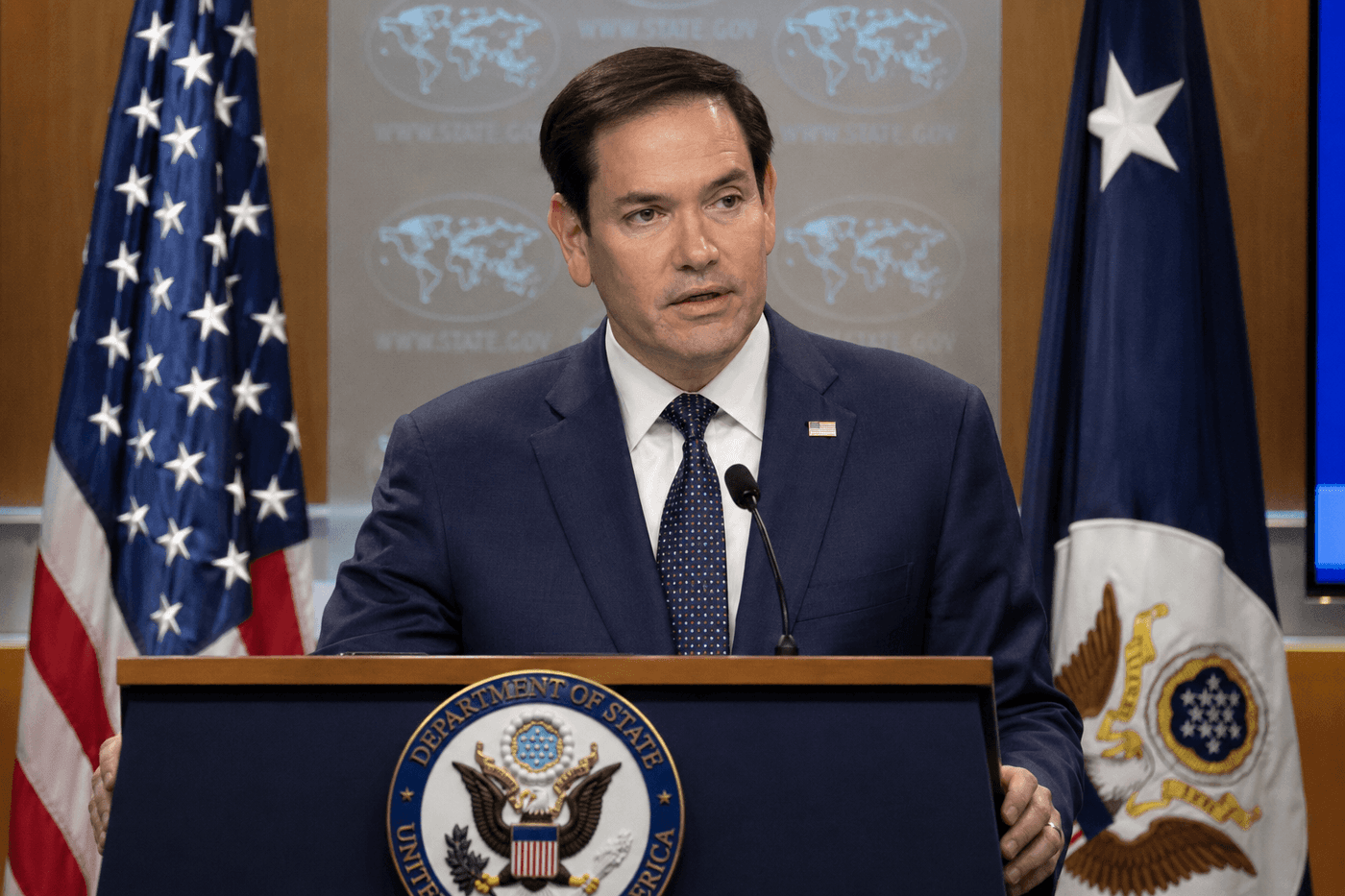
Secretary of State Marco Rubio announced a new round of sanctions against the Cuban regime Tuesday, designating five entities and one member of the extended Castro family in what the State Department is describing as the most aggressive sustained pressure campaign against the Cuban military's financial network in decades.
The designations target entities tied to GAESA — Grupo de Administración Empresarial S.A. — the military-controlled conglomerate that functions as the Castro regime's primary financial engine. Two of the newly designated entities are GAESA-linked financial institutions involved in moving money on the regime's behalf. A third is a GAESA logistics arm that executes the regime's operations across the island. Two additional entities generate revenue for the Cuban government through the exploitation of the island's mineral and metal reserves, including Cuba's state-owned GeoMinera. Finally, Rubio designated the wife of Alejandro Castro Espín — son of former president Raúl Castro and previously designated himself — in a move that signals the U.S. is prepared to hold the extended Castro network financially accountable.
"GAESA continues to operate as the financial muscle behind the Cuban regime's repressive security apparatus. These entities and actors fund, facilitate, or benefit from the regime's malign activities, both in Cuba and across our hemisphere." — Secretary of State Marco Rubio
Tuesday's designations build on a sweeping secondary sanctions package the Trump administration levied against GAESA-linked businesses and banks in early June — a measure that extended pressure to any foreign companies doing business with the regime's military conglomerate, not just entities directly tied to the Cuban government. The administration's approach represents a deliberate effort to sever the Cuban military's access to global financial markets by making the cost of doing business with GAESA prohibitively high for third-party international firms.
GAESA controls an estimated 60% of Cuba's economy, including hotels, retail chains, import and export companies, and financial institutions. Rubio has previously accused GAESA of systematically diverting international aid — including funds intended for ordinary Cuban citizens — into the regime's security and repression apparatus. The designation of GeoMinera specifically targets the Cuban government's ability to generate hard currency through natural resource extraction, a revenue stream that has grown in importance as tourism collapsed in recent years.
President Trump issued Executive Order 14404 on May 1, 2026, authorizing expanded sanctions on those responsible for repression in Cuba and for threats to U.S. national security and foreign policy. Tuesday's designations are made pursuant to that order. The Trump administration's Cuba sanctions campaign represents the broadest U.S. financial pressure on the Cuban regime since the original Helms-Burton Act framework was strengthened under Trump's first term.
The Cuban people have suffered under the Castro regime's boot for over six decades. Every dollar that flows through GAESA is a dollar that sustains a repressive apparatus and denies ordinary Cubans the economic freedom they deserve. Rubio — himself the son of Cuban immigrants who left before Castro consolidated power — understands that reality with a personal clarity that drives the administration's approach. Cutting off the regime's financial oxygen is not a guarantee of freedom for the Cuban people, but it is a necessary condition. Tuesday's designations move that goal meaningfully forward.