
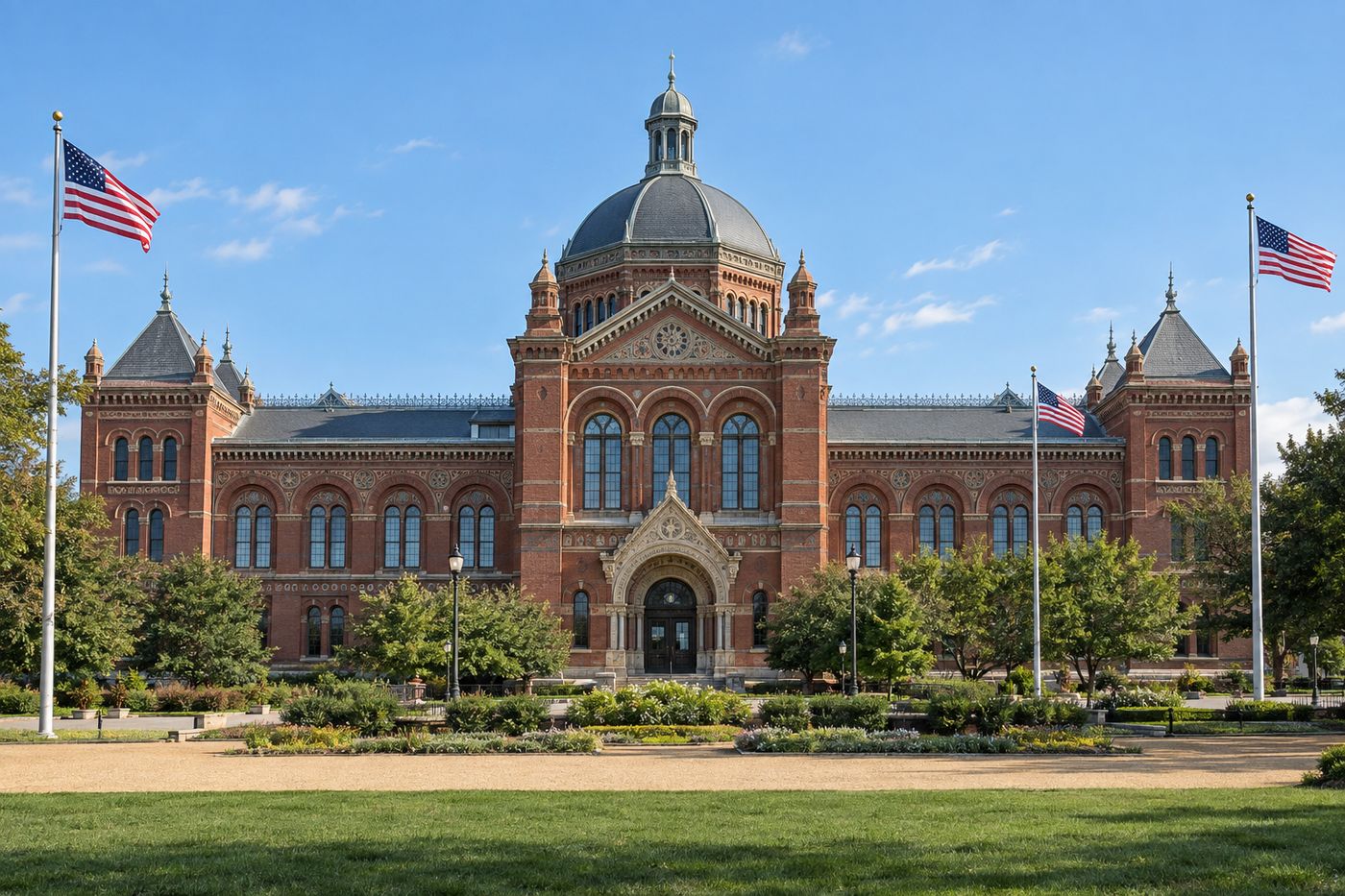
The Smithsonian Institution has designated its Arts and Industries Building on the National Mall as the permanent home of the National Museum of the American Latino — a move critics say was designed to secure the museum's future by placing it in a facility the Smithsonian already controls, avoiding another congressional battle over a museum that conservative scholars and Heritage Foundation researchers argue promotes anti-Western ideology and Marxist messaging under the banner of celebrating Latino heritage.
The selection of the Arts and Industries Building is significant specifically because of what it avoids. Prior site proposals involved National Park Service properties, which would have required new legislation and triggered fresh congressional review of a museum that drew intense scrutiny during House Oversight Committee hearings in July. By selecting a Smithsonian-controlled facility, the institution can move forward without submitting to a new congressional authorization fight. Mike Gonzalez — a former Bush State Department official, Heritage Foundation scholar, and one of the museum's most persistent critics — argued this was precisely the point. "They want to use this as kind of a ruse," Gonzalez said. "They're trying to avoid another congressional fight by placing the museum on property they already control." The announcement came shortly after Smithsonian Secretary Lonnie Bunch III announced his retirement after four decades with the institution, which Gonzalez described as at least partial validation of sustained pressure on the Smithsonian's leadership.
"We need to fire the Smithsonian leadership. We need to get rid of the Latino museum. It needs to be de-authorized. It should not exist." — Mike Gonzalez, Heritage Foundation, on the Smithsonian's decision to designate a permanent home for the American Latino Museum
Gonzalez's published Heritage Foundation report on the museum's inaugural 2022 exhibition — "¡Presente!" — documents what he characterizes as a series of panels reflecting an anti-Western, anti-American worldview. His analysis focuses on exhibits using the phrase "we didn't cross the border, the border crossed us," which he argues is historically inaccurate and primarily used by those who oppose immigration law enforcement; features on drag performers and LGBTQ political figures presented as representative of Latino identity; and the inclusion of Orlando Letelier — a foreign minister under Marxist Chilean President Salvador Allende who died in a 1976 Washington D.C. car bombing — in a museum ostensibly about American Latino history. Gonzalez's report also highlights an exhibit mocking U.S. policy during the Reagan-era Iran-Contra affair while featuring an exhibit on Cuba that omits the Castro brothers' oppressive decades-long rule.
Rep. Carlos Gimenez of Florida — a Smithsonian Regent and Cuban-American himself — has called for the institution to be "fair and balanced" and to "present both sides of the equation." His response reflects the distinction that many critics draw between opposition to the concept of a museum celebrating Latino contributions to American history — which most acknowledge as legitimate and worthwhile — and opposition to a museum that critics argue uses the banner of Latino identity to promote a specific left-wing political worldview that many Latino Americans do not share and would not recognize as their own story.
The Smithsonian Institution receives the majority of its funding from the federal government — approximately $1.1 billion annually in congressional appropriations — making its curatorial decisions a legitimate matter of congressional oversight. The National Museum of the American Latino was authorized by Congress in 2020 as part of a broader museum authorization bill. The Smithsonian's decision to house it in the Arts and Industries Building allows the museum to proceed without submitting its permanent facility to a new congressional authorization, which critics argue would face significantly more skeptical scrutiny than the original 2020 vote.
American taxpayers fund the Smithsonian. The Smithsonian's curatorial decisions — including which figures to celebrate, which events to contextualize, and what ideology to communicate through taxpayer-funded exhibitions — are therefore matters of legitimate public interest and congressional accountability. A museum that features Marxist Chilean political figures, omits Fidel Castro's oppressive rule from exhibits about Cuba, and uses a phrase associated with open-borders advocacy as a framing device for American history is not a neutral celebration of Latino cultural contributions. It is an ideological project — one that the Smithsonian has now arranged to pursue with federal funds in a federally owned facility, with as little additional congressional scrutiny as it can manage to avoid.